
Draft. Version 1.0 (July 2026) is a community draft, open for debate. This page summarises it. The full document is the source of truth.
Regenerative Architecture Principles
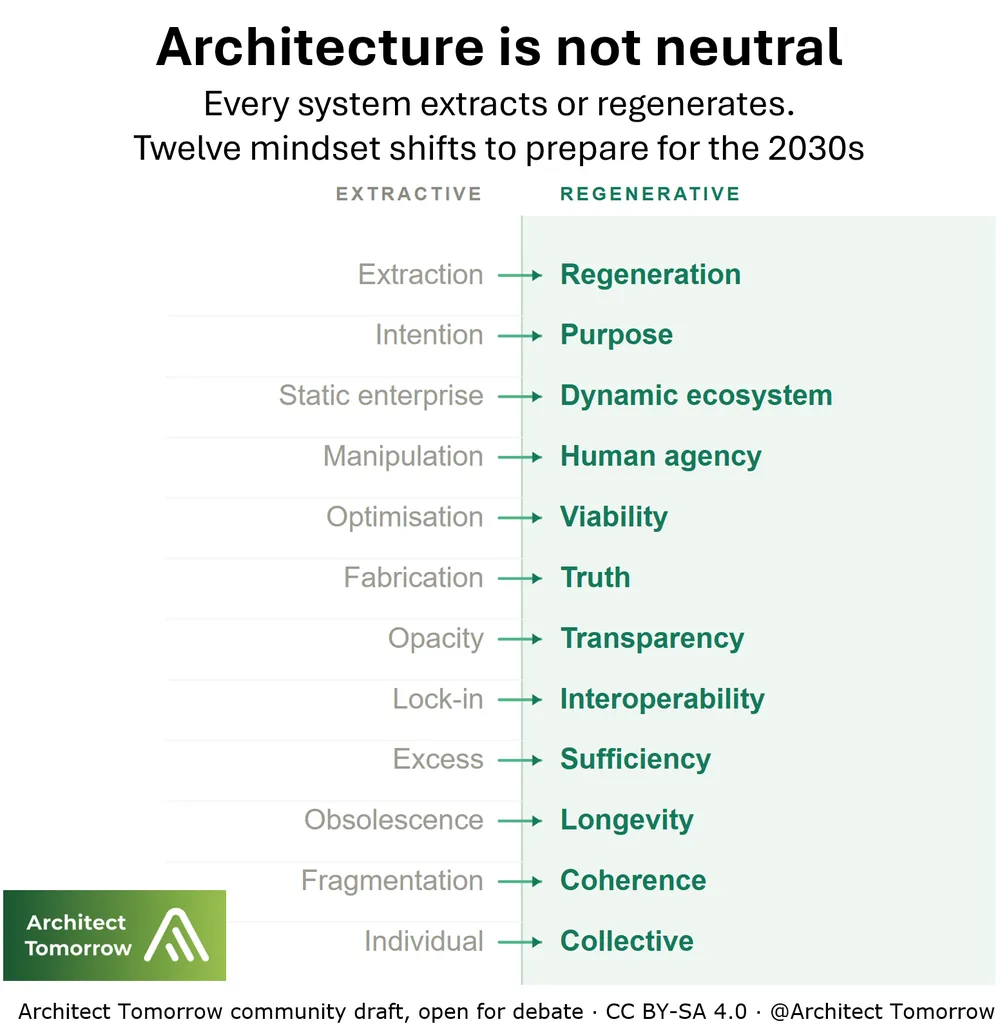
Architecture is not neutral. Every system extracts or regenerates. These principles set out twelve mindset shifts to prepare for the 2030s, drafted with the Architect Tomorrow community for architects and adjacent roles to debate, refine and own.
Read the full document and suggest edits (Google Docs), or read the original article on LinkedIn. Published under CC BY-SA 4.0.
Why we need more conscientious architecture
Systems are increasingly critical to our lives and organisations, and they are not neutral. They support collective wellbeing and freedom, or contribute to suffering. They respect planetary boundaries, or breach them. They support democracy and shared sense-making, or fragment it.
Architects and adjacent roles (product, project, UX, business analysis) hold positions of real influence. As GenAI makes implementation cheaper, our distinctive value moves towards something that cannot be automated: care. Not sentimentality, but disciplined stewardship: noticing who and what a system touches, anticipating harm, and holding the line when optimisation would push costs onto others.
The twelve shifts
| Extractive | Regenerative |
|---|---|
| Extraction | Regeneration |
| Intention | Purpose |
| Static enterprise | Dynamic ecosystem |
| Manipulation | Human agency |
| Optimisation | Viability |
| Fabrication | Truth |
| Opacity | Transparency |
| Lock-in | Interoperability |
| Excess | Sufficiency |
| Obsolescence | Longevity |
| Fragmentation | Coherence |
| Individual | Collective |
The principles in brief
1. Regeneration over extraction
Design for net-positive outcomes, pragmatically balanced across material dimensions. Extractive systems take more than they give: attention, data, energy, materials, social cohesion. “Sustainable” is a floor, not a ceiling. For each resource your system significantly consumes, ask what you are giving back.
2. Purpose over intention
Judge systems by what they do, not what they are meant to do. Using Stafford Beer’s POSIWID (“the purpose of a system is what it does”), declare who benefits, who bears the costs and what externalities are created, and govern the trade-offs rather than implying them.
3. Dynamic ecosystems over static enterprises
Adaptive systems thinking beyond organisational boundaries. Map the full system your architecture materially takes part in, from partners and communities to earth systems, and accept responsibility for downstream effects. As design time and run time blur, governance has to keep pace.
4. Human agency over manipulation
Design systems that support human flourishing and agency rather than manipulate and control. Go beyond “can people use this?” to “what does regular use of this do to people over time?” Preserve the variety (skills, options, perspectives) people need to adapt.
5. Viability over optimisation
Design for long-term sustainability, not single-metric maximisation. Optimising one metric creates fragility and hides costs. Identify what your architecture optimises for, and what is being sacrificed.
6. Truth over fabrication
Data is vital to trust and truth in systems. Govern meaning, provenance and integrity as carefully as any critical component. Surface uncertainty, and treat hallucination and data drift as architectural risks.
7. Transparency over opacity
Make system behaviour legible and contestable to those affected by it. Design for explainability, observability and auditability, with real routes to question, appeal and correct decisions.
8. Interoperability over lock-in
Enable ecosystem participation; design for exit as carefully as for entry. Use open standards, ensure data portability, and ask how hard it is for users or partners to leave.
9. Sufficiency over excess
Right-size for actual need. Challenge requirements inflation, collect only necessary data, and scale to real load, including down to zero where feasible.
10. Longevity over obsolescence
Design for durability, adaptability, repair and graceful evolution. Extend refresh cycles, build for maintainability, and resist hype-driven replacement of working systems.
11. Coherence over fragmentation
Design systems that support shared understanding, not division. Engagement metrics that reward outrage over accuracy turn systems against the societies they serve. Ask whether your architecture rewards bridging or division.
12. Collective over individual
Governance is a top-tier architecture component. Build coalitions, share knowledge, act together. Every system needs accountable owners, decision rights and feedback loops, and individual choices only go so far without shared standards and peer support.
Further principles under discussion
Contributors have proposed more principles, which sit in the full document for debate: fair distribution of ownership and compensation over blunt monetisation, data privacy, and balanced automation over complete automation.
Join in
These are provocations, not commandments. We would love your views on which principles resonate, what is missing, which are hardest to apply and where they conflict.
- Comment and suggest edits in the full document
- Join the conversation on LinkedIn via the Architect Tomorrow page
- Share case studies where the principles worked, or struggled
- A dedicated discussion space is TBC
Significant community contributors: Darryl Carr, Hannah Smith, Selena Evans, Kenneth Igiri, Tom Fairbairn and Sebastian Borgnia, plus members of the Architect Tomorrow and Chief Architect Network communities. The full acknowledgements, foundational thinkers and references are in the document. The work involved responsible use of AI for research and initial articulation, with extensive human review and rewriting.